
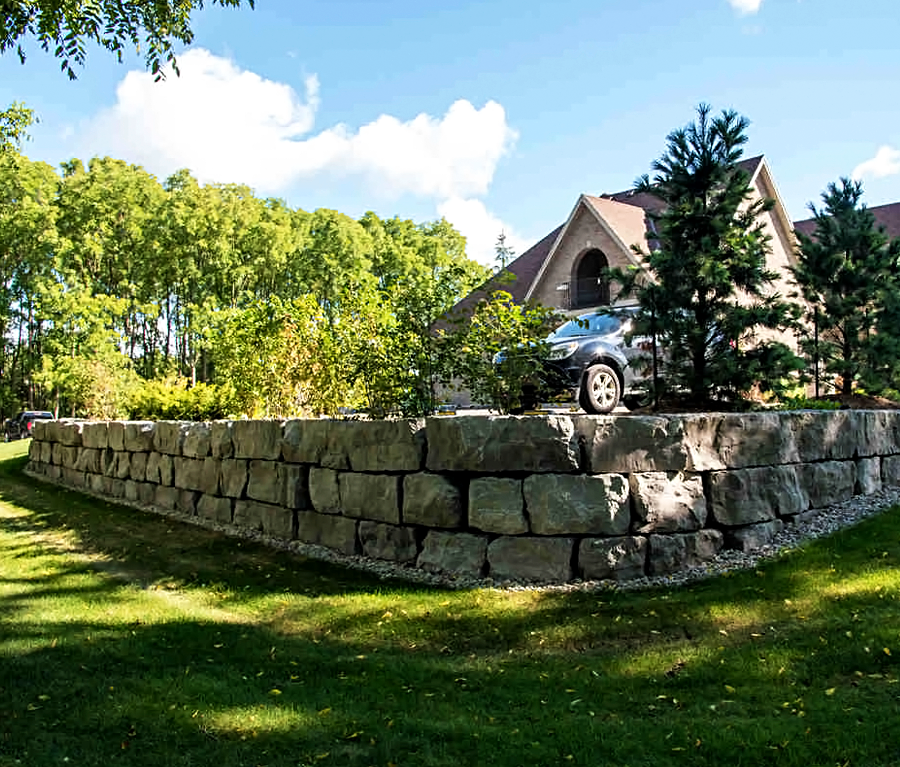
When you need a retaining wall in Toronto, the choice almost always comes down to armour stone vs block (Allan Block / Versa-Lok). Both work, both last decades, and both are the right answer in different situations. This article gives you the contractor-honest comparison so you can make the call before signing a quote.
| Criterion | Armour stone | Segmental block (Allan Block, Versa-Lok) |
|---|---|---|
| Cost / linear ft (4 ft tall) | $250 – $400 | $170 – $310 |
| Lifespan | 75+ years | 30–50 years |
| Installation method | Heavy machinery (excavator) | Manual stacking |
| Engineering needed | Rarely (gravity wall) | Required at 3 ft+ |
| Footprint (back) | Wider (1.2× height) | Narrower (0.7× height) |
| Aesthetic | Rugged, natural | Engineered, uniform |
| Repair / modification | Hard (need machine) | Easy (restack) |
| Best for | Property edges, large slopes, rural lots | Backyards, terraces, tight access |
What is an armour stone retaining wall?
Armour stone walls are built from quarried limestone, granite, or sandstone blocks weighing 1.5 to 4 tons each. The blocks are set on a compacted gravel base with the largest at the bottom, working up. Drainage stone goes behind. No mortar, no rebar, no concrete footing for most heights — gravity does the work.
A typical armour stone retaining wall in Toronto is built with 18″–36″ tall blocks, 4–8 ft long each. They look rugged because they are — the same stone is used along Lake Ontario shoreline and in Don Valley parks for erosion control.
What is a block retaining wall?
Block walls use engineered concrete units that lock together via lips, pins, or geometric profiles. The dominant brands in Toronto are:
- Allan Block (AB) — the GTA workhorse.
- Versa-Lok — premium look, larger blocks.
- Techo-Bloc Mini Creta / Maxi Creta — popular for residential.
Each block weighs 60–110 lbs, so installation is fully manual. They stack with a setback (usually 1″ per course) for stability, and use geogrid reinforcement at heights of 3 ft+.
Cost — apples to apples
For a 30-ft × 4-ft tall retaining wall in Toronto in 2026:
| Armour stone | Allan Block / Versa-Lok | |
|---|---|---|
| Material | $4,200 – $6,800 | $2,400 – $4,500 |
| Excavation + base | $1,800 – $2,800 | $1,500 – $2,400 |
| Drainage (stone + perforated pipe) | $700 – $1,200 | $700 – $1,200 |
| Geogrid reinforcement | n/a | $400 – $900 |
| Skilled labour + machine | $2,400 – $4,200 | $1,800 – $3,200 |
| Engineering | usually $0 | $1,200 – $3,500 |
| Permit, locate, disposal | $400 – $800 | $400 – $800 |
| Total | $9,500 – $15,500 | $8,400 – $16,500 |
For walls under 4 ft tall, block is typically cheaper. For walls over 4 ft, the engineering and geogrid cost on block walls often closes the gap to armour stone.
Lifespan — the long view
Armour stone: 75+ years
Quarried stone does not rot, corrode, or weather meaningfully in Toronto’s climate. The mortar-free construction means there is nothing to fail. Armour stone walls built in the 1970s along Toronto’s ravine system are still structurally sound today.
Block (Allan Block / Versa-Lok): 30–50 years
Concrete blocks slowly weather. After 30–50 years, surface spalling becomes visible, especially on south-facing walls exposed to UV and salt spray. The structural integrity stays sound longer than the cosmetic life — many 40-year-old block walls still hold their slope.
Engineering — the often-skipped line item
In Ontario, any retaining wall over 1 m (≈3.3 ft) tall requires engineering for permit purposes within most GTA municipalities. The engineering letter ($1,200–$3,500) covers:
- Soil bearing capacity
- Surcharge loading
- Geogrid spec (for block walls)
- Drainage detail
- Setback from property line and structures
Armour stone gravity walls often need a simpler engineering review (sometimes none, depending on municipality and height) because the mass of the stone provides stability without geogrid. This is one of the reasons armour stone gets specified for tall walls — fewer engineering steps.
Aesthetics
Pure preference, but here are the clear differences:
Armour stone looks rugged, natural, and timeless. It pairs well with country properties, lakefront cottages, ravine lots, naturalized landscapes, and Ontario heritage homes. The colour is whatever the quarry produces — earth tones, greys, occasional iron oxide reds.
Block walls look engineered and modern. They suit suburban backyards, tight townhouse terraces, contemporary architecture, and pool surrounds where you want clean lines. Colour palette is broad (greys, browns, warm tones, two-tone blends) and consistent across the wall.
Site access — often the deciding factor
This is the silent driver of which material wins on a specific project:
Armour stone needs:
- Truck access for delivery (3-ton blocks come in on flatbeds).
- Excavator or skid steer with stone-handling thumb.
- Pathway from delivery to wall location capable of supporting machinery.
If your wall is in a backyard accessible only through a 4 ft side gate, armour stone is impractical without crane lifts (add $2,000–$5,000 for boom truck or crane day).
Block walls work in:
- Tight spaces (60-lb blocks fit through any gate).
- Backyards with no machinery access.
- Phased projects where you can stack a few hundred blocks at a time.
For most Toronto backyards, this single factor tips the decision toward block walls.
Drainage — where both walls fail without it
Both armour stone and block walls fail the same way without proper drainage:
- Water builds up behind the wall.
- Hydrostatic pressure pushes the wall outward.
- The base shifts, then the wall leans, then it fails.
The fix is the same for both:
- Perforated pipe at the back base, sloped to daylight.
- Drainage stone (3/4″ clear) for the back foot of the wall, full height.
- Geotextile fabric between the drainage stone and the soil behind it.
If your contractor’s quote does not specify these three items by name, walk away from that quote. Drainage is the part that determines whether your wall lasts 30 years or 8 years.
When armour stone wins
- Walls over 4 ft tall on properties with machine access.
- Slopes more than 30 ft long.
- Properties where the rugged natural look matters.
- Lakefront and ravine lots with regulated zones.
- Long-term ownership where the 75-year lifespan matters.
When block walls win
- Backyards with no machinery access.
- Walls under 4 ft tall.
- Modern / contemporary architecture.
- Projects where the cleaner look is the goal.
- Phased budgets where you can split material delivery.
What about interlocking retaining wall (paver block)?
For walls under 2.5 ft, interlocking paver blocks can be a third option. They are cheaper than Allan Block and faster to install, but they are not engineered for serious retaining. Use them for raised flowerbeds and short slope edges only.
FAQ
Which is more expensive — armour stone or block retaining wall? For walls under 4 ft, block is usually cheaper. For walls over 4 ft, armour stone and block are roughly comparable once you add engineering and geogrid costs to the block wall.
Which lasts longer in Toronto — armour stone or block? Armour stone (75+ years) outlasts segmental block (30–50 years) by a meaningful margin. Both will outlast their owners on a typical home.
Do I need engineering for an armour stone wall? Often no for gravity walls under 6 ft. Always confirm with the municipality. Tall armour stone walls and any wall with surcharge load (driveway, pool above) need engineering regardless of material.
Can I install a block retaining wall myself? For walls under 2 ft, yes. Above 3 ft you need engineering and geogrid — and DIY block walls without geogrid are the #1 spring failure call across the GTA.
What about a concrete retaining wall? Poured concrete walls (with stone veneer) are a third option — most expensive upfront ($200–$360/linear ft for 3 ft tall), most engineered, and used mainly for foundation walls and tall walls with surcharge.
For real numbers on your specific slope, see the full retaining wall cost guide or request a free retaining wall quote.




Leave A Comment