
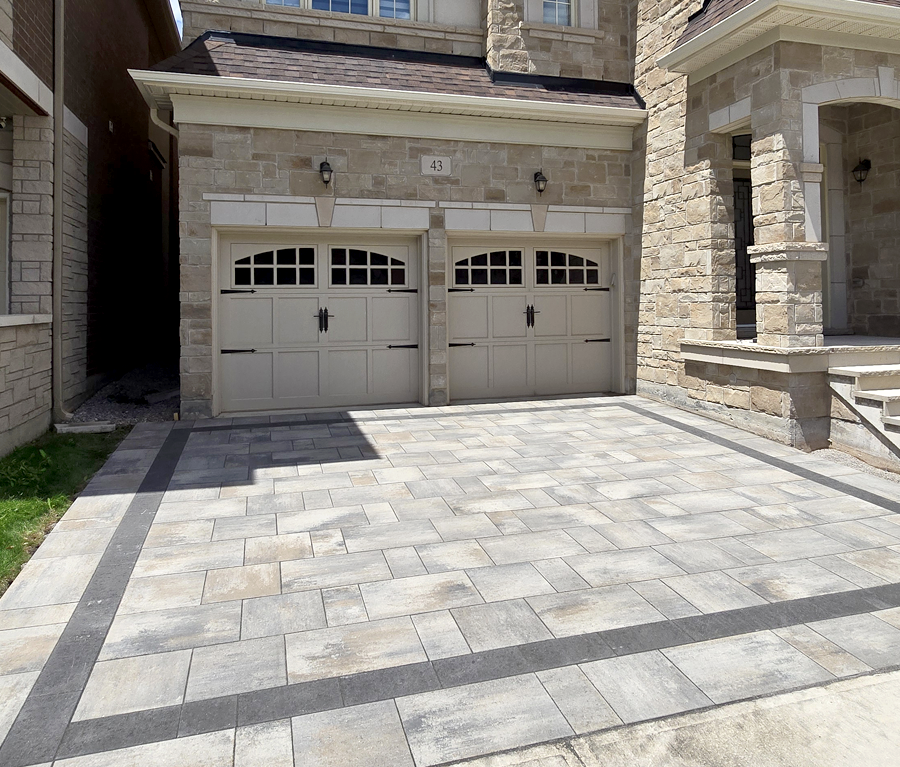
If your interlock driveway has weeds in the joints, a few sunken pavers, or a wavy section that is getting worse every spring, this guide walks you through what you can fix yourself and when to call a contractor. Most Toronto interlock driveways need maintenance every 4–6 years; serious repairs every 12–18.
TL;DR — Interlock Repair Decision Tree
| Problem | DIY? | Cost | Time |
|---|---|---|---|
| Weeds in joints | ✓ Yes | $80–$200 | 1 afternoon |
| Polymeric sand wash-out | ✓ Yes | $150–$400 | 1 day |
| 1–3 sunken pavers | ✓ Yes (with care) | $50–$150 | 2–3 hours |
| Edge restraint failure | ✗ Pro recommended | $400–$1,500 | half-day |
| Wavy section (5+ pavers) | ✗ Pro | $1,200–$4,500 | 1–2 days |
| Paver replacement (matching needed) | ✓ Maybe DIY | varies | varies |
| Tree root upheaval | ✗ Pro (root work) | $2,000–$8,000 | 2–4 days |
| Full base failure | ✗ Pro (rebuild) | $20+/sq ft | 1–2 weeks |
DIY interlock repair — what you can actually do
1. Weeds in joints
The fix: pull weeds, refresh polymeric sand. Tools: stiff brush, garden hose with mist setting, a bag of polymeric sand ($25–$45 per 50 lb bag), a leaf blower.
Steps:
- Wait for a dry forecast (3 dry days minimum).
- Pull or torch existing weeds. Brush all old loose sand from joints.
- Sweep new polymeric sand into joints until full to ~⅛” below the paver surface.
- Use leaf blower to clear sand from paver tops.
- Mist with hose (do not flood) to activate the polymer.
- Let cure 24 hours.
Common DIY mistake: spraying too much water washes the sand out before it sets. Mist, do not pressure-spray.
2. Polymeric sand wash-out
Same fix as weeds — clear the joints, refresh the sand, mist to set. Plan to do this for the whole driveway every 5 years, not just the spots that look thin.
3. Single sunken paver
If one paver has sunk ¼”–½” relative to its neighbours, you can lift and reset it.
Tools: 2 large flathead screwdrivers, knee pads, a small bag of HPB sand, a rubber mallet.
Steps:
- Use screwdrivers to pry the paver up from two opposite corners. Work slowly — chipping the edges is easy.
- Remove the paver. Clean the joint sides.
- Add HPB sand or screening to the bedding to bring the level back up. Compact lightly.
- Set the paver back. Tap with rubber mallet until flush with neighbours.
- Refill polymeric sand in joints around the paver.
- Mist to set.
Limit: do this for 1–3 pavers max. If 5+ pavers in the same area are sunken, you have a base problem — call a pro.
4. Replacing a chipped or cracked paver
Same process as resetting a sunken paver, but you swap in a new paver. The challenge is matching:
- Brand and SKU must match the original (Techo-Bloc Blu 60, Permacon Mondrian, etc.).
- Colour drifts over years from sun and salt — new pavers will look fresher.
- A common pro trick is to swap the new paver into the front centre and move the original (faded) paver to a low-visibility area.
If you cannot identify the original brand and SKU, photograph a paver and bring it to a local supplier (Beaver Valley, Royal Building Materials, ABC Yard) — they can usually identify it.
When to call a contractor for interlock repair
Edge restraint failure
The plastic or metal edge along the driveway perimeter is what holds the entire system together. When it fails:
- Outer pavers drift outward.
- Joints open up.
- Polymeric sand washes out continuously.
DIY edge replacement is possible but requires lifting the perimeter row of pavers, removing old edge restraint, installing new (with 10″ spikes every 12″), and resetting. Pro repair costs $400–$1,500 for a typical driveway perimeter.
Wavy / heaving section
If you have 5+ pavers showing as a wave, dip, or heave, the base under that section has failed. This is almost always:
- Inadequate base depth (the original installer cut corners).
- Poor compaction (the base settled differentially).
- Tree root growth pushing pavers up.
- Frost heave on a section without proper drainage.
The fix is to lift the affected section, dig down to find the issue, repair the base, and reset. Pro cost: $1,200–$4,500 depending on area.
Tree root damage
Tree roots growing under an interlock driveway lift pavers and crack the system over years. Repair requires:
- Lifting pavers in the affected area.
- Root cutting (which can damage the tree — consult an arborist for trees you want to keep).
- Re-prepping base.
- Resetting pavers.
Toronto neighbourhoods with large maples (Cabbagetown, Annex, Beaches) see this every 12–18 years.
Full base failure
If most of the driveway shows waves, sinking, or open joints, the base prep at the original install was insufficient. The fix is a full rebuild — lift all pavers, excavate, install proper Granular A base, geotextile, edge restraint, and reset (or replace) pavers.
This is essentially a new interlocking driveway installation at full cost ($20+ per sq ft). The good news is that the original pavers can usually be reused, saving 30–40% versus a from-scratch install.
Common Toronto interlock repair mistakes
- Using regular sand instead of polymeric sand — washes out within 1 winter.
- Pressure-washing the joints — strips polymeric sand, causes future weed problems.
- Salt for ice management — accelerates wear on non-rated pavers. Use sand, kitty litter, or magnesium chloride instead.
- Ignoring edge restraint failure — the cascade leads to whole-driveway repair.
- Sealing the wrong year — sealing pavers within the first 12 months traps construction efflorescence and looks blotchy permanently.
Maintenance schedule that prevents repairs
| Year | Action | Cost |
|---|---|---|
| Every spring | Inspect joints, top up polymeric sand spots | $0–$50 |
| Every 5 years | Full polymeric sand refresh | $400–$900 |
| Every 5–7 years | Optional sealing (penetrating sealer) | $600–$1,500 |
| Every 8–10 years | Reset any sunken pavers | $0–$400 |
| Every 12–18 years | Edge restraint replacement | $400–$1,500 |
| Every 25+ years | Full base rebuild and paver reset | $20+/sq ft |
This schedule extends a Toronto interlock driveway’s life from a typical 25 years to 40+.
FAQ
How much does interlock driveway repair cost in Toronto? $50–$400 for DIY-friendly fixes (single pavers, sand). $1,200–$4,500 for sectional rebuilds. $20+ per sq ft for full base rebuilds.
Can I repair sunken interlock pavers myself? Yes for 1–3 pavers in the same area. Pry up, add bedding sand, reset, refill polymeric sand, mist. If 5+ are sunken, call a contractor — base problem.
How often should I refresh polymeric sand on my Toronto driveway? Every 4–6 years. Spot-fix every spring as needed.
Is pressure washing safe for interlock pavers? The pavers themselves yes; the joints no. Pressure water strips polymeric sand and causes weed and erosion problems. Use a fan tip from 12+ inches away, or skip pressure washing entirely.
Do I need to seal my interlock driveway? Optional. Sealing slows colour fade and makes future cleaning easier, but un-sealed Toronto-rated pavers last 25+ years on their own. Wait at least 12 months after install before any sealer.
For repairs beyond DIY scope, request a free repair quote — we will walk the driveway with you and tell you whether it needs a section fix or a full rebuild.




Leave A Comment